


Nature - 2019 September - Vol 573 No 7775
Publisher: Nature
Format: Paperback
ISBN: 9770028083095
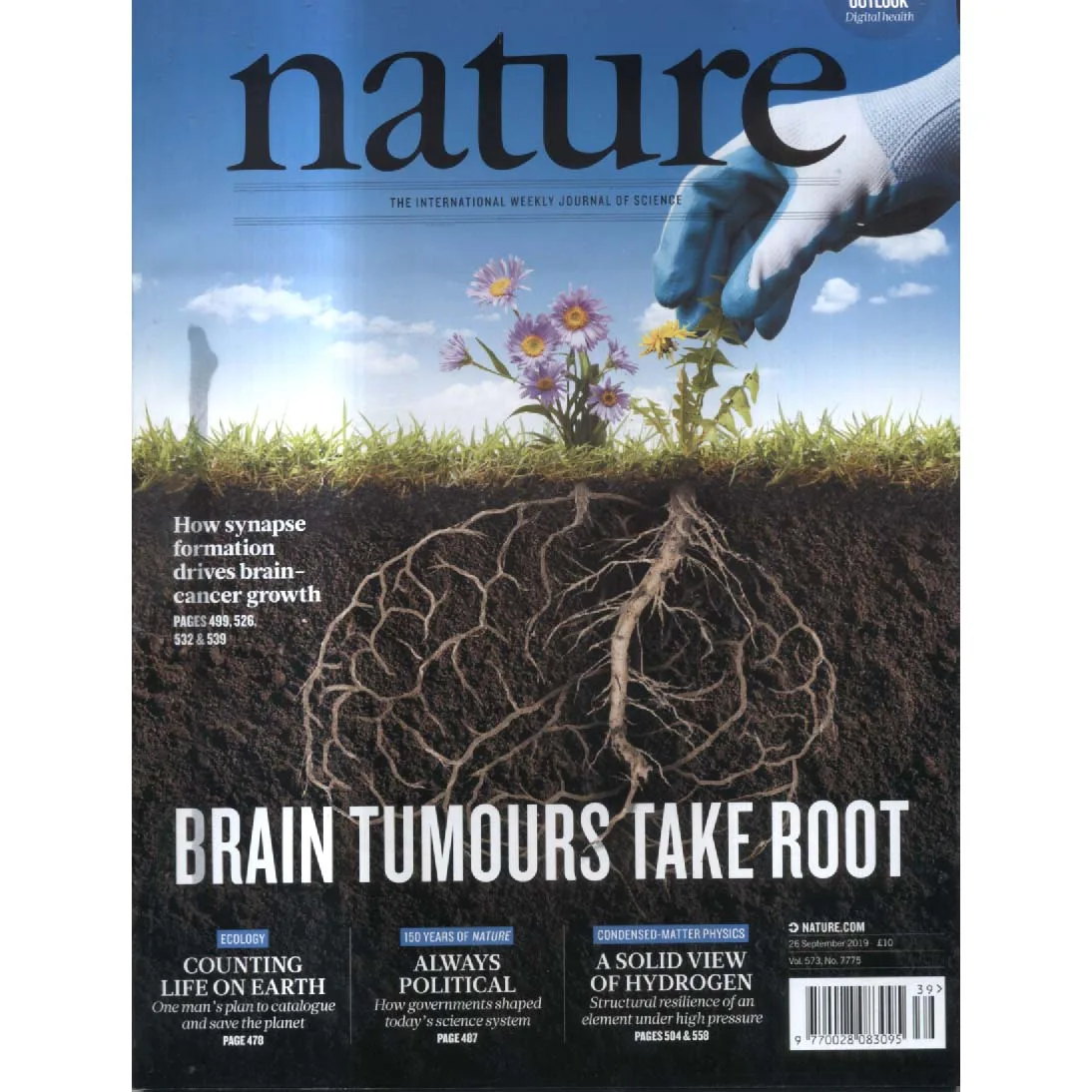
There are magazine covers that gently invite you in, and then there are covers like Nature – September 2019, Vol. 573 No. 7775, which confronts you with the phrase “BRAIN TUMOURS TAKE ROOT” beneath an image of flowers whose roots form the shape of a human brain. It is subtle only in the sense that a cathedral organ is subtle.
This issue perfectly captures the unique Nature ability to transform cutting-edge biomedical research into something visually poetic, intellectually intimidating, and faintly existential all at once. The lead feature explores how synapse formation drives brain-cancer growth, which is one of those sentences that reminds you modern science now operates at a level where diseases are being analysed with the narrative complexity of political thrillers.
The cover artwork is genuinely brilliant. A gloved hand tends flowers above ground while hidden beneath the soil lurks a branching neural root system, quietly suggesting that biology is forever plotting something more complicated underneath the surface. It feels like the poster for an arthouse film about oncology directed by someone who owns several turtlenecks and speaks entirely in metaphors.
And because this is Nature, the issue refuses to limit itself to merely one profound scientific revelation. Elsewhere inside, there are efforts to catalogue all life on Earth, condensed-matter physicists wrestling hydrogen into bizarre new forms under immense pressure, and reflections on how politics shaped the scientific system over the journal’s 150-year history. Few publications can move seamlessly from planetary biodiversity to the political architecture of science itself without suffering conceptual whiplash.
That is really the enduring charm of Nature. It assumes readers are perfectly comfortable spending breakfast contemplating cancer biology, high-pressure hydrogen structures, and the fate of global ecosystems before heading off to buy milk. The magazine has always maintained this extraordinary editorial confidence: civilisation may be balancing on the edge of biological, ecological, and technological transformation, but everything will still be presented in neat columns with tasteful typography.
Naturally, owning a copy of Nature also broadcasts a certain intellectual aspiration. Leaving it on a coffee table silently announces: “I occasionally engage with advanced discussions on neuroscience and ecological cataloguing.” Whether you have actually read beyond the first paragraph of the hydrogen article is immaterial. The important thing is that you theoretically could.
This September 2019 issue now feels particularly evocative of the late-2010s scientific atmosphere — a period when researchers were increasingly uncovering how deeply interconnected everything was: brains, ecosystems, politics, technology, all tangled together in systems of alarming complexity. It was an era where scientific progress felt both hopeful and mildly terrifying, often within the same article.
Condition is listed as Good, meaning this copy has survived the traditional hazards of serious scientific periodicals: heavy backpacks, office desks belonging to people with unread journal piles, postgraduate caffeine incidents, and several years of someone promising themselves they would definitely return to the article about hydrogen “when they had more time”.
An outstanding issue for science enthusiasts, medical-history readers, biology obsessives, or anyone who enjoys magazines that casually combine oncology, planetary biodiversity, and condensed-matter physics into one beautifully unsettling package.
Keep browsing: See more Nature Journal books Other books by Nature
